Aesthetic botulinum toxin — Product, equipment, marking and technique area by area
Which product and how to reconstitute it, the equipment needed, the pre-treatment record, technique and doses for each facial area, and the errors producing a dropped brow, startled look or asymmetric smile.
Content intended for healthcare professionals. It does not replace clinical assessment and is not written as patient information.
Key points
- Toxin does not erase wrinkles: it weakens the muscle that produces them. Everything else — dose, point, depth — follows from knowing which muscle it is and in which layer.
- The rule that prevents most trouble: always inject 1.5 cm or more above the brow. The closer to the brow, the likelier it drops.
- Depth is not a detail: superficial is 2 mm and deep is 4 mm, and that changes muscle and result.
- The session does not end at the injection: retouch at two weeks if needed, and do not repeat treatment before three months.
- The indicative total upper-third dose is 50 units in men and 40 in women, and the point pattern also changes with sex.
Choosing the product
The available formulations are neither interchangeable nor convertible by a simple ratio: each has its own unit and its own dosing, so a dose scheme is valid only for the product it was written for. In practice one works mostly with 50 and 100 unit vials, and there is a clinical consideration worth bearing in mind: in patients with an autoimmune history, formulations with a lower complexing-protein load are preferred, for their lower theoretical immunogenicity. In facial palsy a difference in duration between formulations has been described at four weeks, favouring the longer-acting ones; in aesthetics that difference matters less because the interval between sessions is already long, but it is worth noting in patients who report that "it does not last".
Reconstitution: two equivalences worth memorising
| Vial | Diluent | Resulting concentration |
|---|---|---|
| 100 units | 2.5 ml of saline | 4 units per 0.1 ml in a 1 ml syringe |
| 50 units | 1 ml of saline, or 1 % lidocaine to reduce discomfort | 5 units per 0.1 ml |
The equipment
- 1 ml syringe with luer lock: the threaded fitting stops the needle detaching when injecting against resistance.
- 21 G, 40 mm needle for drawing up, and 0.9 % saline.
- 30 G, 13 mm needle for injecting: cheaper and with lower injection pressure. 33 G needles are easier to handle and faster.
- A white marker: mark, erase and inject over it with no trace left.
- For discomfort, topical anaesthetic cream 30 minutes beforehand on the most sensitive areas, and ice.
- For the masseter, a longer, 31 G needle, because 13 mm of depth must be reached.
The pre-treatment record, always the same
- Video rather than a stillVideo captures the dynamics, which is what all this is about. First the gentle expression, then the forced one
- “Smile showing your canines”Tests orbicularis and crow’s feet
- “Raise your brows”Tests frontalis: its strength, lateral extent and asymmetries
- “Frown, look angry”Tests the glabella and corrugators
- Record before injectingBrow height, frontalis strength, skin elasticity and pre-existing asymmetries. What is not recorded beforehand later looks caused by the treatment
- AfterwardsRetouch at two weeks if needed. Do not repeat treatment before three months
Four technical rules that apply everywhere
- Bevel facing outward, except where the indication specifies otherwise.
- Inject with the muscle contracting: this locates the belly producing the wrinkle, which is exactly where the product should go.
- Faced with asymmetry, add units on the overworking side rather than reducing on the underworking one.
- Superficial is 2 mm and deep is 4 mm. On the forehead one works at around 3 mm.
The forehead: the anti-Mephisto point and the W pattern
The problem with the forehead is not relaxing the horizontal lines, which is easy: it is relaxing them without the brow dropping and without it peaking. Hence the marking starts by locating the anti-Mephisto point, found simply: pressing with a finger on the glabella and observing where the maximum height of the brow tail falls. From that point a W is drawn across the forehead. Two numbers do the rest of the work: always inject 1.5 cm or more above the brow — going closer makes it drop — and distribute the dose as 4 units at the upper points and 2 at the lower ones, because the low frontalis fibres are the ones holding the brow up. Depth, around 3 mm.
The three forehead variants
In men, higher doses — around 4 units per point — and points in parallel lines rather than a W, because the goal is maintaining brow horizontality, a masculine feature. In short foreheads, drop to 2 units per point: the margin between relaxing and dropping the brow is far narrower when there is less distance between hairline and brow. And a third situation that turns up at review: if a comma-shaped line forms above the brow tail because the lateral frontalis compensates, it is resolved with 2 very superficial units in that specific spot.
Area by area: point, depth and dose
| Area | Where and how | Dose |
|---|---|---|
| Forehead | W pattern from the anti-Mephisto point, always 1.5 cm or more from the brow. Depth 3 mm | 4 U above, 2 U below. In men, 4 U per point in parallel lines |
| Corrugator | Enter perpendicular and deep at the medial insertion; more superficial laterally. Check whether the corrugator is long or short | 2.5 to 5 U per point depending on muscle strength |
| Procerus | Central area, deep and with the needle angled upward | 2.5 to 5 U |
| Crow’s feet | Three points: 1 cm lateral to the outer canthus, 1 cm above touching the orbital rim, and 1 cm below. Needle very superficial, 2 mm, until a papule appears, and parallel | 2 U per point. If the lines are long, add two points, one lateral and one medial |
| Bunny lines | Transverse nasalis, one point on each side of the dorsum | 2 U per side. If the nose widens on smiling, add one point at the columellar base |
| Gummy smile | 1 cm lateral to the alar cartilage and 1 cm above the perpendicular from the commissure. Depth 3 mm | 2 to 4 U at most |
| Barcode lines | Orbicularis oris, inserting only the bevel | 2 U per point |
| Marionette lines | Depressor anguli oris, near the mandible and more than 1 cm from the commissure | 2.5 U per side |
| Platysmal bands | Points along the band only where visible, 1 cm apart, and superficial | 2 U per point |
Opening the gaze without touching frontalis
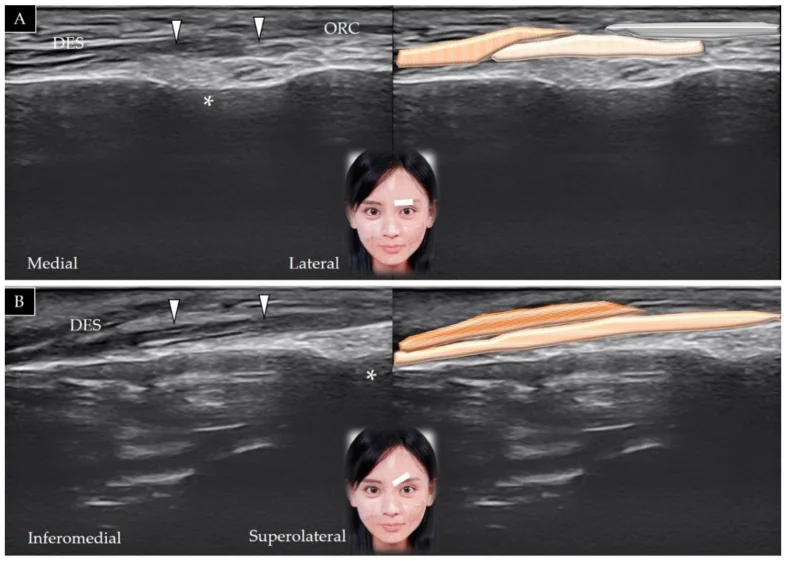
It is the most elegant manoeuvre in the whole upper third, and it consists of not doing the obvious thing. To raise the brow one does not stimulate the elevator — that is not possible — but blocks the depressors: a well-infiltrated corrugator and procerus raise the medial portion, and one point at the brow tail touching the orbital rim removes the downward pull of the lateral orbicularis. That opens the gaze. What matters is the negative instruction: do not inject frontalis while doing this, because blocking elevator and depressors together raises nothing and leaves the forehead immobile. It is also why, if the forehead is treated, the depressors must always be treated to compensate.
Three precautions that get forgotten
First, in the crow’s feet: in patients with eye bags or poor tear-trough circulation, do not load the area with points. Orbicularis contributes to lymphatic drainage and blocking it worsens the bag. Second, from the zygomatic muscles down: paralysing muscles there produces the Joker face, so injection must be very superficial and low dose, and only in the belly forming the wrinkle. Third, the most general: inject into each muscle belly that produces a wrinkle, not at a theoretical point, because the mimetic muscle’s motor endplates are spread throughout the belly rather than grouped in a band.
Indications that are not aesthetic
| Indication | Technique | Dose |
|---|---|---|
| Bruxism and myofascial syndrome | Masseter with a longer, 31 G needle, at 13 mm depth, always lateral to the anterior margin. Add one point at the temporomandibular joint and another in temporalis, asking the patient to clench to locate it | 50 units per side, spread across the masseter points plus 0.1 ml at the joint and 0.1 ml in temporalis |
| Frey syndrome | Intradermal infiltration of the affected area, mapped beforehand | According to the area involved. This is a functional, not aesthetic indication |
| Incised wound scars | At the time of suturing, infiltrate the adjacent musculature to reduce dynamic tension on the suture line | Low dose. It connects with the scar revision note: tension is what widens and hypertrophies |
The patient returns at two weeks unhappy
What exactly is it they dislike?
What to say before starting
- That the effect is not immediate: it starts within days and peaks between four and six weeks.
- That review is at two weeks and that the retouch is part of the treatment, not a correction of an error.
- That already static lines do not disappear: toxin stops them etching further, but an established line needs resurfacing or volume.
- That if filler is used in the same session, the order is filler with its massage first, then toxin; if in separate sessions, toxin first.
- And that pre-existing asymmetries will still be there: hence they are pointed out and recorded before injecting.
References
- 1.de Maio M, Swift A, Signorini M, Fagien S. Facial assessment and injection guide for botulinum toxin and injectable hyaluronic acid fillers: focus on the upper face. Plast Reconstr Surg. 2017;140(2):265e-276e.
- 2.de Maio M, DeBoulle K, Swift A, Peng P, Weiner S. Facial assessment and injection guide for botulinum toxin and injectable hyaluronic acid fillers: focus on the midface. Plast Reconstr Surg. 2017;140(4):540e-550e.
- 3.de Maio M, Wu WTL, Goodman GJ, Monheit G. Facial assessment and injection guide for botulinum toxin and injectable hyaluronic acid fillers: focus on the lower face. Plast Reconstr Surg. 2017;140(3):393e-404e.
- 4.Happak W, Liu J, Burggasser G, Flowers A, Gruber H, Freilinger G. Human facial muscles: dimensions, motor endplate distribution, and presence of muscle fibers with multiple endplates. Anat Rec. 1997;249(2):276-284.
- 5.Knize DM. An anatomically based study of the mechanism of eyebrow ptosis. Plast Reconstr Surg. 1996;97(7):1321-1333.
Related specialty: Facial Aesthetic Surgery