Skin envelope — The layer that decides how much of our work shows
Thick and thin skin as two different operations, the skin-thickness by cartilage-strength matrix, and the role of the musculature in the nasofrontal angle, projection and rotation.
Content intended for healthcare professionals. It does not replace clinical assessment and is not written as patient information.
Key points
- The nose is an elastic envelope over a supporting framework. We modify the framework, but what the patient sees is how the skin adapts to it.
- Skin thickness determines two things: the intensity of retraction and how readily any framework irregularity shows through.
- Technique is decided not by thickness alone but by thickness crossed with cartilage strength: four distinct scenarios, not two.
- In thin skin, avoid subcutaneous grafts: any edge shows. In thick skin, thinning the subcutaneous layer to define the tip usually disappoints, because that skin scars excessively.
- The musculature is not scenery: procerus influences the nasofrontal angle, nasalis and Pitanguy’s ligament projection, and the depressor septi rotation.
The first thing to assess in a nose
Before looking at the skeleton it pays to look at what covers it, and not only to classify it as thin or thick. In the envelope one looks for scars, tumours, atrophy with telangiectasia, underlying fibrosis — showing as surface undulations — and rhinophyma. Any of these changes the plan: atrophic skin does not tolerate what healthy skin does, previous fibrosis conditions the degloving, and rhinophyma may need its own treatment before or after the rhinoplasty.
The principle governing the whole operation
The nose consists of an elastic envelope and a solid supporting framework, and when the latter is modified the skin adapts and reflects the underlying architecture. It sounds obvious but has consequences: the result is not what we leave in theatre but what the envelope does with it over the following months. And that depends on three variables: the thickness of skin, subcutaneous tissue and muscle, its degree of retraction and the intensity of the scarring reaction. Two patients with the same final skeleton can end up with different noses because of those three.
Thick and thin skin: two different operations
| Thick skin | Thin skin | |
|---|---|---|
| Main risk | Persistent oedema, fibrosis and supratip formation | That any framework defect becomes visible |
| Retraction | Exaggerated. It can deform the tip cartilages if they are thin | Slight. The problem is not retraction but skin adherence to bone or cartilage |
| Achievable definition | Limited. The envelope damps the relief however well the work beneath is done | Very high, but with no margin for error: every edge shows |
| Grafts | Well tolerated. This is where projecting to define makes sense | Avoid subcutaneous ones. If used, interpose a camouflage layer |
The supratip in thick skin has three origins, not one
When a supratip appears in a thick-skinned patient the temptation is to blame the thickness and wait. Two other causes should be excluded first, both treatable and both worse if left: a haematoma and dead space left beneath the skin. That is, a thick-skin supratip may be from the skin, from accumulated blood, or from lack of apposition between envelope and framework. Only the first is managed with patience; the other two, the sooner the better.
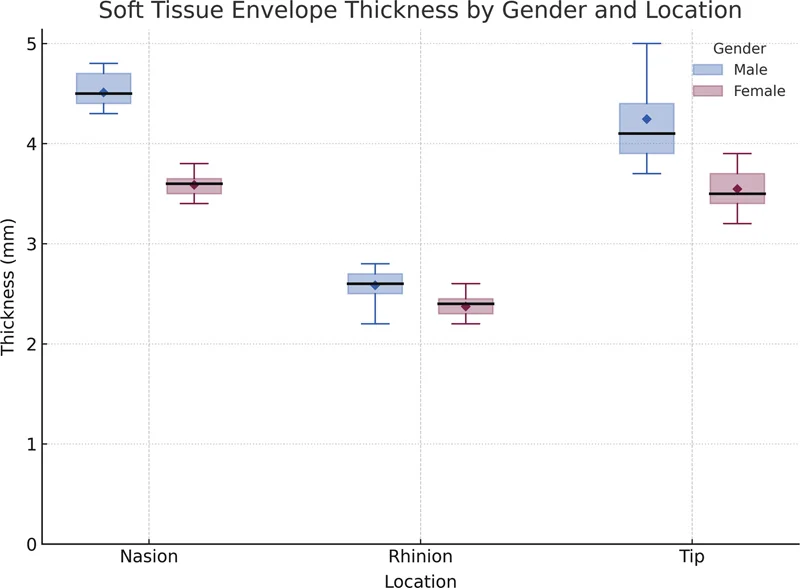
The matrix that really decides the technique
Classifying skin as thin or thick falls short, because the same thickness behaves differently according to the strength of the cartilage beneath. Combining both variables gives four scenarios, each demanding a different strategy. Cartilage strength is tested by something as simple as pressing the tip with a finger and noting how much it yields and how much it recovers. It is worth doing at the first consultation and recording, because it is data no photograph contains.
Skin thickness × cartilage strength
| Scenario | Strategy |
|---|---|
| Thin skin + strong cartilage | The most rewarding scenario. Sutures and a columellar strut suffice for projection and definition. Mind every edge, since everything shows |
| Thick skin + strong cartilage | Project with onlay grafts so the relief comes through the envelope. Trimming alar cartilages or thinning the subcutaneous layer to define usually disappoints: that skin scars excessively |
| Thick skin + weak cartilage | The most demanding. One must rebuild support and also project: structure first, grafts second. Consider the premaxillary floor to gain projection |
| Thin skin + weak cartilage | The risky combination. Reinforcement is needed, but every graft shows through: use finely shaved cartilage and camouflage with fascia or perichondrium |
Skin retraction can deform the cartilage
This is the most underestimated interaction. Thick skin favours exaggerated cutaneous retraction, and that force, sustained over months, can deform the tip cartilages if they are thin. Put another way: in the thick-skin, weak-cartilage scenario the envelope not only hides the work but can dismantle it from outside. This is why in that patient profile it pays to over-build the structural support rather than rely on sutures, which give way.
Skin excess in the older patient
In older patients the skin has lost elasticity, and after a reduction rhinoplasty an excess of skin or wrinkling may remain that does not retract. In extreme cases the surplus must be resected, leaving a horizontal, barely visible scar at the upper dorsum. It is an infrequent manoeuvre and worth anticipating in consultation, because a patient not expecting an external scar takes it badly even when well camouflaged. The alternative is to reduce less: in aged skin, planning a moderate reduction usually gives a better overall result than an aggressive one followed by skin resection.
The musculature also decides the result
| Structure | What it alters if untreated |
|---|---|
| Procerus | Reduction or loss of the nasofrontal angle |
| Nasalis and Pitanguy’s ligament | Inadequate tip projection |
| Depressor septi nasi | Insufficient rotation of the tip, and dynamic droop on smiling |
Before deciding the tip technique
Pinching the skin of the dorsum and tip, is it thin or thick?
Pressing the tip with a finger, does the cartilage resist or yield?
What to say in consultation
Skin thickness is the variable that most frustrates expectations when not explained before surgery, because it is the only important one the patient cannot see and the surgeon cannot change. In thick skin, three concrete things should be said: that achievable definition is lower however well the work beneath is done, that oedema will last months longer than they have read, and that the definitive result may take 18 months or more. Said beforehand it is a starting condition; said afterwards it sounds like an excuse.
References
- 1.Arquero P. Alteraciones nasales: alteraciones de la cobertura. rinoplastia.eu.
- 2.Sclafani AP, ed. Rhinoplasty: The Experts’ Reference. New York: Thieme; 2015.
- 3.Çakır B. Aesthetic Septorhinoplasty. Cham: Springer; 2016.
- 4.Daniel RK, Palhazi P. Rhinoplasty: An Anatomical and Clinical Atlas. Cham: Springer; 2018.
Related specialty: Rhinoplasty